Masquerade
Did Diane Paulus leave all thoughts of the world she knew before?

A Brief Overture
Although I was a child of the 80s, my parents did not introduce me to theatergoing with the mega-musicals that were then dominating the Great White Way. My first Broadway show was Gypsy with Linda Lavin. My second was City of Angels. My third was Gypsy with Tyne Daly (when the press described her return as “by popular demand,” they very may well have been referring to me). My fourth was Grease!—okay, a populist outlier—and my fifth was Kiss of the Spider Woman.
It wasn’t until I got to college that I realized most of my fellow theatre kids were obsessed (or at least introduced to our shared passion) with different shows than me. So, I asked my mother, “Why didn’t you start me out with the shows everyone else has seen? The Phantom of the Opera and Cats and Les Miz?” She looked at me like I was crazy and said, “Because they’re BAD.”
Finally, in 2010–motivated by a combination of curiosity, completism, and the sentimentality that comes with age—my mom and I went to see Phantom. Andrew Lloyd Webber, Charles Hart, and Richard Stilgoe’s adaptation of Gaston Leroux’s novel tells the tale of a mysterious figure who haunts a Paris opera house as he stalks/mentors/romances a young singer named Christine. She finds herself torn between this Phantom and her childhood sweetheart, the wealthy, worked-out, and bland-beyond-belief Raoul. When people criticize Phantom, they usually focus on the bluster and repetitiveness of Webber’s melodies, and its generic, often nonsensical lyrics. What doesn’t get enough attention is that all three of these characters are terrible people.
At any rate, 2010 was one of the worst times anyone could have caught Phantom’s record-breaking run—long after it set new standards for Broadway spectacle and memorable “popera” music, but years before its closing notice reportedly reinvigorated the production. The cast was on such autopilot, the visuals looked so in need of a refresh, and the audience was so disinterested that the experience reminded me of visiting Disney’s Hall of Presidents: robotic performers and once revolutionary (but now outdated) technology dispassionately dispensing a familiar story that’s boring everyone who’s watching.
Curtain Up
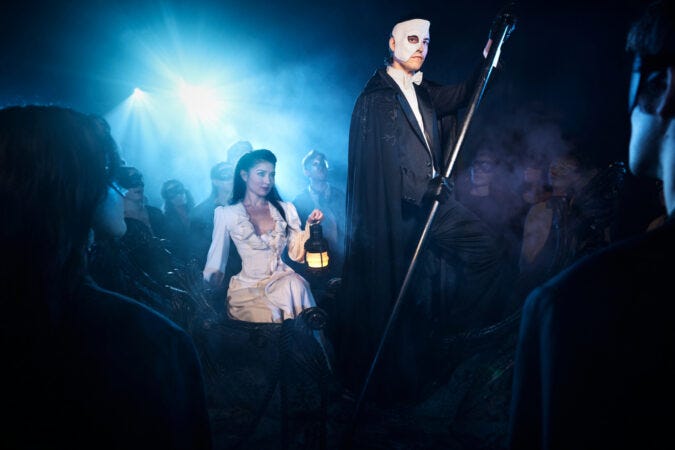
About two years after Phantom closed with the bragging rights of being the longest running show in Broadway history,1 it was reimagined by director Diane Paulus as Masquerade, a two-hour immersive experience that opened off-Broadway in Sept. 2025, aspiring to be musical theatre’s answer to Sleep No More. When word broke that audiences would be required to dress formally and wear masks (Venetian or domino, not KN-95), there was some eye-rolling across town. When folks started hearing the ticket prices, which generally start at $175, it escalated to grumbling. However, most of the complaints started dissipating after the start of performances, which generated surprisingly positive buzz.
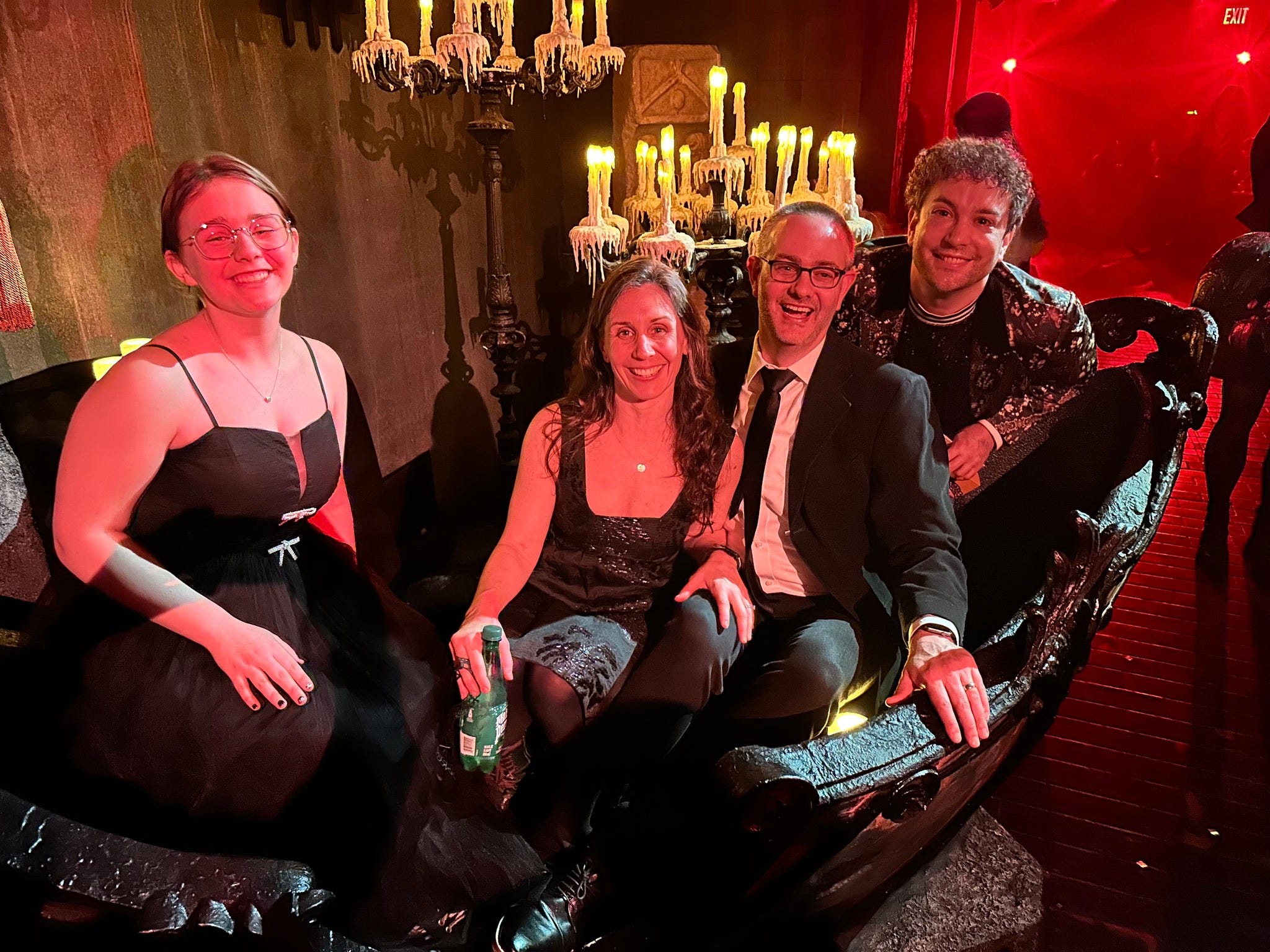
Still, I resisted seeing it…because of my underwhelming experience with Phantom, the hefty price tag, a pair of meniscus tears, and a general wariness of immersive theatre, which I tend to find more gimmicky than revelatory. But when my beloved college roommate Kaye told me she was coming to town, it seemed like the obvious choice—not only because it was a musical that we, who met study musical theatre, could experience for the first time together, but also because the many years her husband Allen (the unofficial fifth roommate in our apartment) has spent working in production have included immersive events. What really sealed the deal? We’d be joined by their creative and wise-beyond-her-years 13 year old daughter Blair. I found myself thinking of that underrated Gloria Estefan ballad “Christmas Through Your Eyes,” hoping I could see immersive theatre through Blair’s eyes.
And I did.
To a certain extent.
Because Masquerade is simultaneously not Phantom and still Phantom.
Gone are the entire orchestra; most of the subplot focusing on opera diva Carlotta and the theater’s managers; and the overall impression of maximalism, despite Hal Prince’s deceptively minimalistic staging. Newly added are a click track; extensive backstory about the Phantom’s childhood, which incorporates a song from Joe Schumacher’s soporific film version; and a sustained affect of intimacy, despite Paulus’s objectively maximalistic staging. (There is one live musician, a violinist, Nikita Yermak at the performance I attended. Yermak plays so superbly, it reminds you there is no substitute for a live instrumentalist.) Preserved are all the big songs that Phans want to hear, like “Think of Me,” “Music of the Night,” and the title number; an unwavering commitment to Victorian melodrama; and the distinct sense that you’re visiting a Disney attraction…only this time it’s the Haunted Mansion.
The sumptuousness of the physical production Paulus has assembled with a very large creative team is dazzling—and likely would be even without your own cynicism support tween. Production designer James Fluhr, scenic designer Scott Pask, and costume designer Emilio Sosa are true masters of their crafts. For most of the action, they transport you to another time and place so successfully, it’s jarring when you’re ushered onto escalators and a contemporary Manhattan roof for scene changes. A huge part of why the evening feels like a Disney attraction is that no expense seems to have been spared in expanding the Phantom and Christine’s world beyond a traditional proscenium.
Conversely, a major reason why the evening feels intimate—despite its sprawling across multiple rooms, sets, levels, and floors—is the unusual proximity the audience has to the cast. Masquerade is performed several times a night, each performance referred to as a “pulse,” to accommodate staggered arrivals of groups of about 60.2 Moving around in these small groups allows the audience to get close to the performers…literally.
While a few of the roles are played by the same indefatigable actors in every pulse, the Phantom and Christine are each cast with six different actors and Raoul is cast with three. If this sounds like an SAT problem to you, an example might help: assuming there were no absences, while everyone who attended Masquerade the same night as me saw Matthew Curlano as André, only my group saw Clay Singer as the Phantom, Riley Noland as Christine, and Francisco Javier González as Raoul; however, one other group saw González opposite a different Phantom and Christine. Regardless of my reservations about the material and its execution—which, like a frustrating amount of environmental theatre, frequently prioritizes “vibes” over storytelling—it was a privilege to be inches away from vocalists of such a high caliber as they sang. I was particularly taken with the clarity and placement of Noland’s stunning soprano.
Sadly, it does not seem that Paulus has allowed her cast any more latitude for personalizing their characters than Prince did in his famously standardized staging. Every gesture, cadence, and piece of blocking seems as choreographed and devoid of spontaneity in Masquerade as it did in Phantom. And much of it is so stylized, it feels like colonialized kabuki. The ensemble, especially the wholeheartedly committed Singer, never comment on the artificiality of what they’re doing, but that doesn’t make it feel less artificial.
Nearly every Paulus-staging I’ve seen has contained both moments of goosebump-inducing brilliance and moments of cringeworthy, sometimes even juvenile, heavy-handedness. Thanks to Paulus’s considerable talent, her productions usually contain more of the former than the latter, but Masquerade is no exception. Its last scene alone had a spectacular bit of theatrical magic that made me gasp and an obvious metaphor that made me groan.
My response to those final few minutes is a pretty fair reflection of my experience at Masquerade as a whole. I wish that Paulus had created a whole new world, one that transformed the Phantom we already knew instead of augmenting it. At the same time, the narrative clarity I craved was often most obscured when she did venture into the unknown. Maybe I should let it go, but I’ve got a dream that I’ll one day see a piece of immersive theatre that is as rich in storytelling as it is in environmental inventiveness. Although Masquerade is, at best, almost there, I am glad that there are creatives as daring as Paulus out there.
the not-a-bottom line
🌈🌈½ (out of five)
a key to the pictures
Masquerade’s current sextet of Phantoms sing “Music of the Night” on Broadway.com
Production designer James Fluhr gives Broadway.com a tour of the performance space
The title of “Broadway’s longest running show” will almost certainly be usurped by The Lion King and maybe even Chicago.
IMPORTANT TANGENT: Brooke Shields was in my group, looking as fabulous as you would expect and interacting with other group members, when appropriate, with incredible warmth and consideration. When Blair was positioned behind her at one point, Shields insisted they switch places. “I’m very tall!” she whispered with a friendly laugh. More importantly, she smelled amazing. Like…I don’t think I have ever been around a better smelling person in my entire life.
the irony of a face reveal in the most famous show about masks!
This made me like your mom 😂 You’re going to have to see Jellicle Ball now!