Ragtime
It was the music of IP that's thinning, of content eroding, why Lion King's winning...

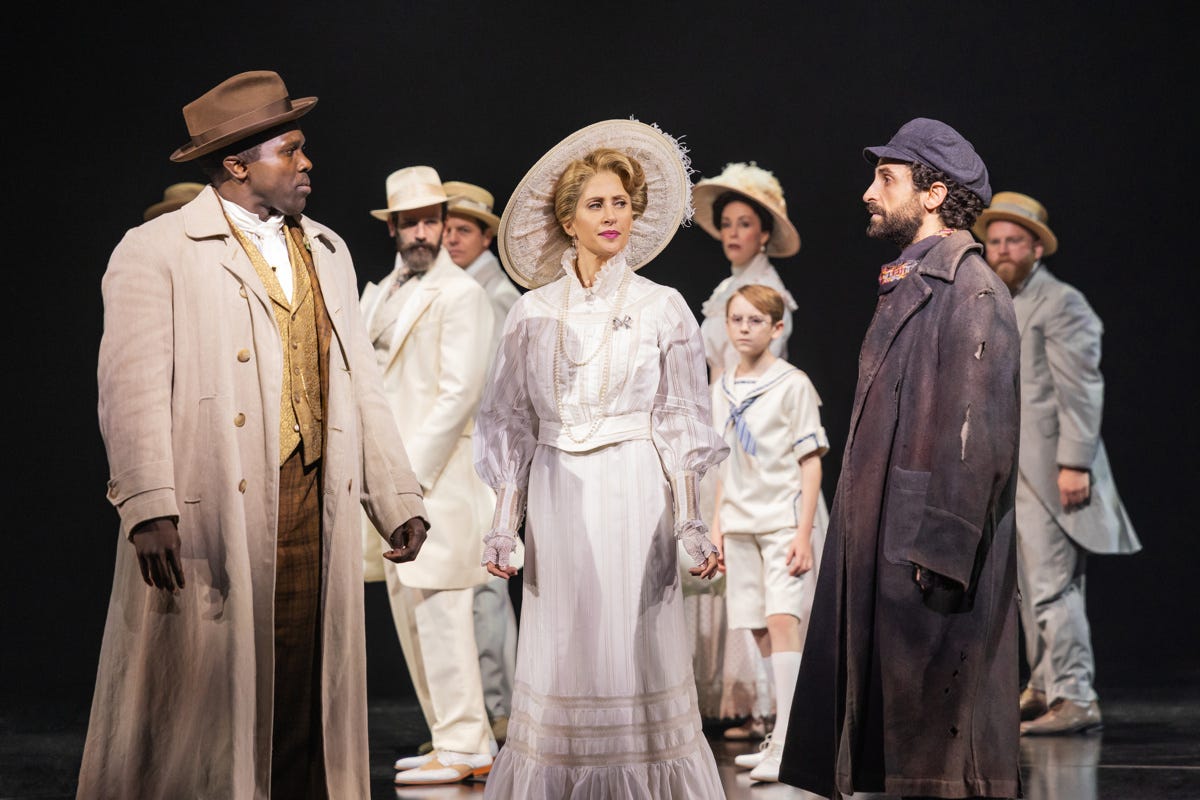
Let’s just rip this Band-Aid off: I don’t think Ragtime is a good musical. In fact, I think Ragtime might be the worst written musical that is widely regarded as a well written musical.
Yes, it includes some gorgeous songs, especially “Wheels of a Dream,” “Your Daddy’s Son,” “Make Them Hear You,” and “Back to Before.” But gorgeous songs do not, on their own, add up to a good musical. This is an art form that synthesizes—or, at least, SHOULD synthesize—music with lyrics and libretti, as well as production-specific elements like direction, choreography, and design. As beautiful and memorable as many of Stephen Flaherty’s melodies are, they cannot make up for Lynn Ahrens’s Hallmark-commercial lyrics; the sanitized stiltedness, tonal whiplash, and monolithic characters of Terrence McNally’s book; or, in Lincoln Center’s current revival, director Lear deBessonet’s amateurish staging.
I’ve always wondered how much of my leaning negative on Ragtime was due to my having seen the original production with a tired replacement cast who was phoning it in for a conspicuously small house as the show limped toward closing. But the revival boasts a sensational cast and has become quite a hot ticket, playing to enthusiastic and packed houses (which, on the night I attended, included definitely-not-lesbian-lovers Christine Baranski and King Princess). Watching such sublime talents perform for such an appreciative crowd, it became clear my problems are with the material itself.
McNally’s script lifts a lot of narration from its source material, EL Doctorow’s brilliant novel of the same name, but maintains little of its danger and even less of its titillation. It juxtaposes the stories of Mother (Caissie Levy), the matriarch of an affluent white family; Coalhouse Walker Jr. (Joshua Henry), a Black musician courting the mother of his child (Nichelle Lewis); and Tateh, a Jewish immigrant (Brandon Uranowitz) fighting to provide a better life for his daughter. These families’ interactions with each other are positioned as a sort of microcosm of the ways their cultures intersected and diverged at the turn of the 20th Century.
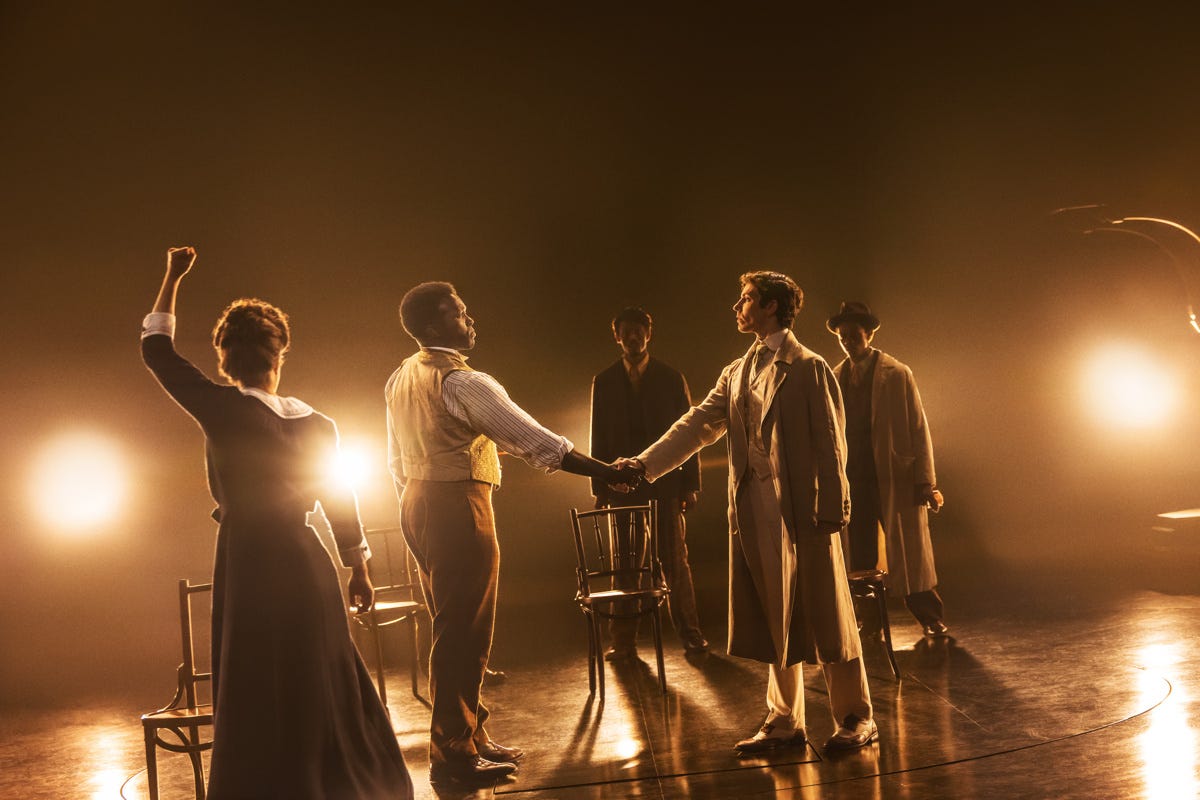
McNally also preserves Doctorow’s intermingling of fictional characters with actual historic figures, including Emma Goldman (Julie Benko, filling in for Shaina Taub through March 29), Booker T. Washington (John Clay III), Harry Houdini (Rodd Cyrus), Evelyn Nesbit (Anna Grace Barlow), J.P. Morgan (John Rapson), and Henry Ford (Jason Forbach)—at least half of whom feel thrown in here for historical color rather than dramaturgical function. They’re reflective of a larger problem in the adaption that occurs on both the narrative and thematic levels: while the scope of the novel feels epic and expansive, with each of its many characters serving a crucial purpose, the focus of the musical feels diffuse. Even divorced from a comparative perspective, the characters in the musical still come off as reductive, each defined by a single purpose, which prevents real three-dimensionality.
And that’s a shame because their collective story feels particularly relevant now, given the horrific rise—or at least normalization—of racism and anti-immigrant sentiment that is plaguing America. Subject matter this serious and wide-reaching deserves more probing and sophisticated examination than is offered by the musical, which too frequently defaults to easy morality and excessive reportage. Even when it addresses the complexity of its characters’ choices, it manages to sound overly tidy and pat. Consider, for example, this lyric from one of the show’s surplus of capital-A-Anthems:
And say to those who blame us
for the way we chose to fight
that sometimes there are battles
which are more than black or white.
If I read those words in a high school literary magazine, I’d be impressed. However, in a Tony Award winning score, I expect more than Snapple cap wisdom in an ABCB rhyme scheme.
One way to disguise such pedestrian drivel? Have Joshua Henry deliver it. So powerful is his singing, he could probably make one of Trump’s state of the Union addresses sound profound. That he fails to find as many levels here—both musically and dramatically—as he usually does falls squarely at the feet of deBessonet, who either did not ask him or did not guide him to show the range he has demonstrated elsewhere. Still, his performance has an undeniable impact.1
deBessonet seems to have taken a similarly hands-off approach with Lewis, a thrilling singer whose defining character choice seems to be “blank slate.” Levy and Uranowitz fare much better. Uranowitz2 summons such raw devotion to his onstage daughter, you almost forget that it’s essentially his character’s single trait. He also uses his flawless comic timing to create some welcome moments of levity. After an exceptional star-turn in London’s Next to Normal, which you can and should watch on BroadwayHD or PBS Passport, Levy’s performance as Mother offers further proof that she is more than her effortless belt. She turns her big song into a musical epiphany that is fleshed out with the kind of specificity I long for in the rest of the show. Best of all might be Ben Levi Ross in the economically written role of Mother’s Younger Brother. Whenever he’s onstage, Ross infuses Ragtime with the combustible energy and revolutionary spirit that should drive the entire piece.
What we get instead is similar to a soundtracked museum diorama. It’s curated stasis that is supposed to convey the force and inevitability of change. The pretty music might make you feel something; ultimately, though, it’s all too lifeless to provide any sharper insight into history. Consequently, Ragtime lets down not only the Coalhouses and Tatehs and Mothers of yesterday, but also the Coalhouses and Tatehs and Mothers of today. They deserve better.
the not-a-bottom line
🌈🌈 (out of five)
a guide to ticket-buying
Sit as close to center as possible, even if it means moving farther back in the house.
a key to the pictures
The cast performs “The Prologue” on Good Morning America
Joshua Henry performs “Make Them Hear You” on The View
Caissie Levy performs “Back To Before” on Today
Joshua Henry and Nichelle Lewis perform “Wheels of a Dream” on The Late Show with Stephen Colbert
If I didn’t find Ragtime so frustrating, I would return to see Coalhouse performed by Clay, who is Henry’s understudy and alternate. Clay stole every scene he had in the short-lived New York, New York and is very compelling as Washington despite having relatively little to do. He is definitely a star on the rise.
Full disclosure: Uranowitz and I worked together in 2010.
This might just break Jon's heart. I'm still looking forward to seeing it! But I'll also have your voice somewhere in the back of my head during it.
I disagree on seat placement! I sat house center 2 rows in front of the sound booth and though one of the leads (who I’d never heard before) had an ugly, strident voice. I saw it again way house right and she sounded great! I also couldn’t hear any adlibs,hubbub, etc from the center! The sound is not good there.