Chess
Breathe in through your nose and out through your mouth: this is a long one.

The Opening
Since I started this substack—almost a year ago!—a handful of people have accused me of being an ecdysiast a hater because I don’t hold back when a production dissatisfies me. This is especially true when I cross-post to the hellscape that is Facebook. One troll said I was “like Hitler” for describing the complex experience of contemplating Nicole Scherzinger’s political leanings while watching Sunset Blvd. As someone who’s Jew-ish, I *wish* Hitler’s crimes against humanity were restricted to bitchy bon mots.
So, I want to take this moment to make it clear that when I sit down at a theater, I desperately want to love whatever I’m about to see. Nothing thrills me more than a show that moves me, makes me laugh, and/or inspires me to think. There is truly no way to spend three hours that I find more blissful than attending a play or musical. (And, to paraphrase the musical Dirty Rotten Scoundrels, I don’t even like to have sex or eat bacon for three hours!) I feel like I am live theatre’s biggest cheerleader; so, if my reaction to a disappointing production seems harsh, perhaps it’s best to think of it as analogous to the response of someone who’s been betrayed in a relationship with a close friend or cherished family member: the pain is particularly acute because something precious has been compromised.
I provide this lengthy prologue to illustrate that I went into the revival of Mess Chess genuinely wanting it to be great. In fact, I bought my ticket suspecting it would be my last show of the year, hoping it’d finish 2025 with a bang. What unfolded was more like the sound of Debbie Downer’s trombone.
Of course, I was aware of the musical’s long history of proving problematic to stage: every major production of Chess has struggled to transform its beloved score, which began as a concept album, into a dramatically satisfying musical, maybe because it began as a concept album. Ever since the musical was overhauled in the transfer of its original production from the West End to Broadway, revising Chess has become almost synonymous with producing Chess. Countless creatives have tried (and failed) to find political resonance in its story of an American and Russian facing off at a world championship chess match during the Cold War, while also fleshing out the love rectangle in which the players and their female partners are caught. Nevertheless…
The Middlegame
…I was cautiously optimistic that a new book by Emmy-winning writer Danny Strong would comprise the winning material1 to fix Chess for its first Broadway revival, which recently opened at the Imperial Theater. Other than having never written the libretto of a musical, which is a *significant* caveat, Strong seemed like an excellent fit for the material. In his scripts for the HBO films Game Change and Recount, he compellingly told the respective stories of Sarah Palin’s 2008 run for Vice President, and the fallout from the 2000 presidential election, accentuating the excitement in politics and humanity in politicians. In his two-part screenplay for The Hunger Games: Mockingjay, he resisted condescending to the melodrama of the YA-fiction that was his source material and somehow made a woman’s choice between two men feel as important as her saving the world.
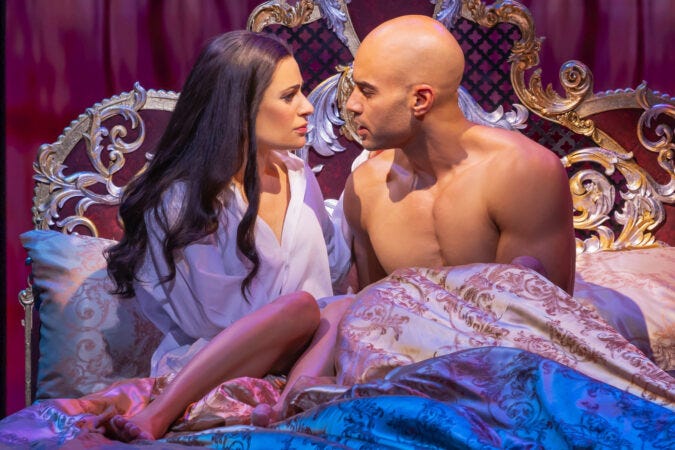
Strong’s affinity for these subjects and tropes immediately appears in his reworking of Chess. From the first entrance of cocky American chess champion Freddie Trumper (Aaron Tveit) and his second Florence Vassy (Lea Michele), we’re told—literally told by our narrator, who also acts as the chess championship’s Arbiter (Bryce Pinkham)—that they’re a couple with a turbulent past, in no small part because Freddie lives with bipolar disorder and potentially paranoid schizophrenia. It’s made similarly explicit in Florence’s first scene with the nihilistic Russian champion Anatoly Sergievsky (Nicholas Christopher) that they have some sort of aborted romantic history. Anatoly would like to reinvigorate it despite his having a wife, Svetlana (Hannah Cruz), whom he insists entered into the marriage only because the government demanded she do it for show. Does this sound like a lot? It is. And it’s just the first 15 minutes.
You may have noticed that I didn’t introduce either of the women with an adjective. And that’s because, as many times as the dialogue states she’s brilliant, Florence has no discernible personality. We only meet Svetlana in Act Two, at which point she is embittered, endangered, and sharing an entirely different account of her marriage than the one we’ve been led to believe in Act One. It’s…confusing. The intended takeaway here may be that two people can have different experiences of the same relationship, but the change in narrative feels more like a plot device than an exploration of subjective reality.
Strong’s most overt political changes are resetting Act One to 1979 amidst American and Soviet negotiations for the SALT-II arms treaty, and Act Two to 1983 when the Soviets believed the U.S. was using NATO’s Able Archer military exercise as a cover to launch a real attack. In an obvious but ludicrous effort to raise the stakes and make the audience actually care about chess—although nothing in the staging suggests director Michael Mayer does—Strong ties the outcome of the chess matches to the outcomes of these events. In other words, if the Soviets lose the chess matches, they’ll walk away from the treaty in Act One and (I guess?) launch a nuclear war in Act Two. Most of these plot points come in exposition-heavy dialogue between Molokov (Bradley Dean), Anatoly’s second who also happens to be a KGB agent, and CIA agent Walter (Sean Allan Krill). Both Dean and Krill are to be commended for taking thankless scenes and finding all the dramatic tension they can in them.
No matter how farfetched or empty the scenes are, the cast plays them with dutiful sincerity. Unfortunately, it’s at terrible odds with the Arbiter’s annoyingly meta narration: he repeatedly refers to what we’re watching as “our Cold War musical,” he comments on Michele’s belting, and he makes cringeworthy “topical” jokes connecting the events of the musical to today’s political landscape and figures. They elicit some obligatory laughs and rounds of applause, but mostly you just feel the audience’s discomfort. Pinkham delivers his entire performance, even choreography, in quotes. It’s off-putting and undercuts the attempted seriousness of everything surrounding it. The overall effect suggests that Mayer and Strong wanted their cast to commit wholeheartedly to the material, but couldn’t do it themselves. They snark at the show to telegraph that they’re smart enough to know it’s flawed, even though they were the people charged with remedying those flaws. It’s the old Gypsy Rose Lee trick: “No one laughs at me because I laugh first!”2
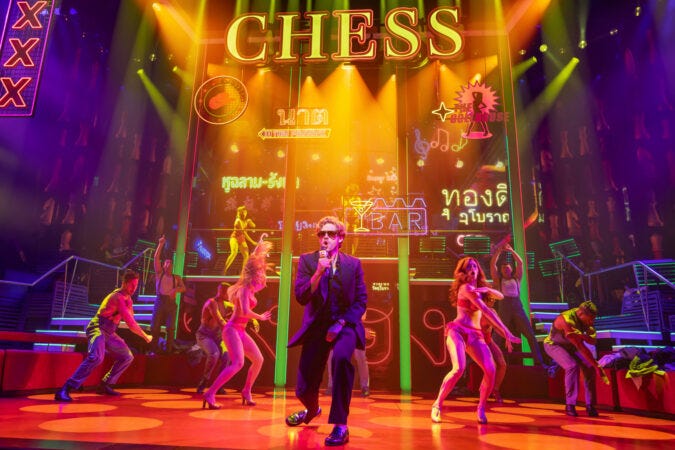
The physical production does little to build out the world or articulate a powerful concept. When the curtain rises, it reveals a series of staircases and platforms with the orchestra seated onstage. I immediately thought of the long-running revival of Chicago. Its streamlined design, which includes the orchestra in a giant jury box, may have begun as a necessity (originally, it was envisioned only as a concert reading at Encores!), but it was ultimately integral to the production becoming a phenomenon: with no bells and whistles, all the focus is on the writing, the choreography, the performers, etc. When I saw how sparse David Rockwell’s set design of Chess was, I thought, “Wow! Bold! He and Mayer really trust the material.” In a matter of minutes, I was proven wrong. Various embellishments, including some heavy-handed projections and Lorin Latarro’s characteristically busy choreography, appear as distractions without ever making the production look less cheap or feel more coherent.
Tom Broecker’s costumes and Kevin Adams’s frequently rock concert–like lighting rely on a lot of red and blue to indicate who’s American and who’s Soviet—though Svetlana, whose allegiances are called into question, switches from dark red/burgundy to…wait for it…PURPLE! Otherwise, the principals are mostly costumed without regard to geography or period, despite the story being so rooted in a specific era and in specific places (each act includes a song about the city where it takes place!). Michele’s costumes, a black jumpsuit in the first act and a white dress in the second, feel particularly “staged reading,” heightening the lack of specificity in her character.
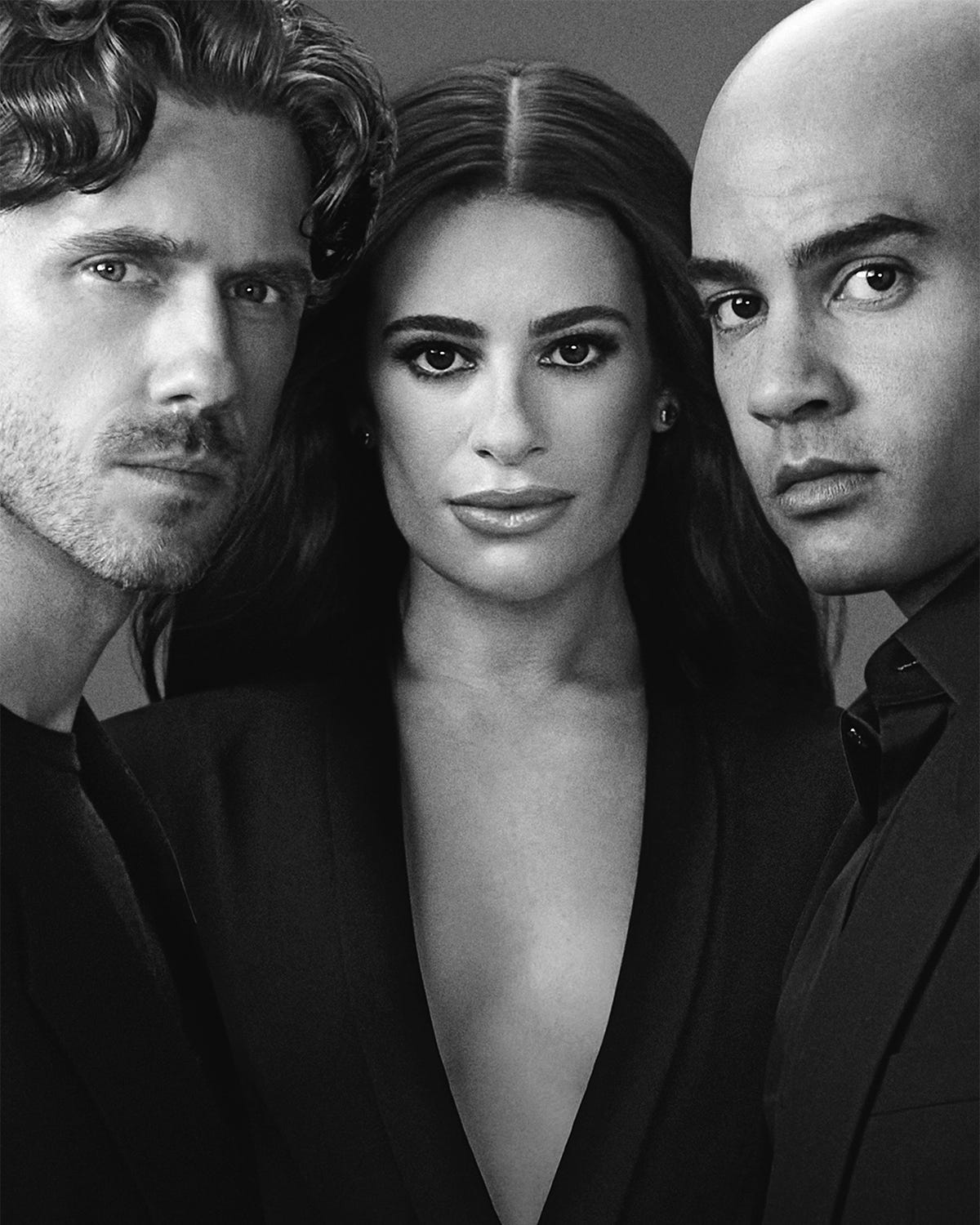
Which brings us to those photogenic principals, whose brooding, contiguous faces are plastered all over the show’s marketing as if Chess were a 90s nighttime soap taking out full page ads in TV Guide. As pretty as all of them are, in the playing of the show, neither the Tveit/Michele pairing nor the Christopher/Michele pairing is built on much chemistry. Michele seems most intimately connected to her wigs, Tveit to his high notes. However, Anatoly’s reunion with Svetlana is incredibly sexy, even though Christopher and (the often terrific) Cruz are both fully clothed and almost perfectly still.
Tveit’s agents may have negotiated top billing, but Michele is likely the bigger draw, particularly after her critically acclaimed and commercially lucrative run in Funny Girl.3 As much as Strong’s new book tries to center Florence, both writer and actress fail to ever convey a clear sense of who she is. I found myself longing for the bold personality of someone like the original Florence, Elaine Paige. Still, Michele sings splendidly and does an adequate imitation of acting; Tveit sings splendidly and does not. I’m beginning to wonder if his glorious performance in Next to Normal—the only interesting work I’ve ever seen him do—was effective because he is essentially blank. In that role, it was an asset, a quality that allowed audiences to project whatever they wanted onto a character who was intentionally idealized. In Catch Me If You Can, Moulin Rouge, and here, his blankness is a liability. His beautiful singing and dashing looks prevent him from being completely boring, but they don’t prevent him from being something that may, dramaturgically, be worse: a tabula rasa.
Christopher, on the other hand, is exceptional. Vocally, he seems capable of anything. His instrument resonates with power and clarity at every place in his register, but the quality of his sound is also infused with emotion. His acting vibrates with a unique intensity that is perfect for his tortured character, and yet he brings surprising tenderness to his most romantic scenes. It’s a triumphant performance that confirms Christopher is one of Broadway’s most dynamic leading men.
The Endgame
What’s fascinating is that in spite of all the changes that have been made over the years, the best part of this revival of Chess as a whole is what has always been the best part of Chess: the score. Music and lyrics are equally credited to Benny Andersson, Tim Rice, and Björn Ulvaeus, but, predictably, all sources indicate that Andersson and Ulvaeus (of ABBA fame) are mostly responsible for the former and Rice is mostly responsible for the latter. As in nearly all of Rice’s work, Chess’s lyrics include some passages that make no sense, but nevertheless work on an emotional level (see: pretty much all of “I Know Him So Well”)…and other passages that make no sense at all.
Regardless, the sheer number of songs that slap is astounding: the aforementioned “I Know Him So Well,” “One Night in Bangkok,” “Nobody’s Side,” “Someone Else’s Story,” “Where I Want To Be,” “Anthem,” “Pity the Child,” “The Arbiter (I Know the Score),” and “Heaven Help My Heart.” Even a lot of the recitative is musically interesting.
In the end, though, a musical is more than a playlist. Chess is the perfect negative example of how important a libretto is, and how underappreciated good book writers are. I assume there will be additional attempts to overhaul Chess in the future, and I hope they work. For now, if Strong asked me whether his version works, I’d have to reply with the name of a different board game: “Sorry.”
the not-a-bottom line
🌈🌈 ½ (out of five)
a guide to ticket-buying
Chess is a fairly hot ticket right now. I haven’t yet seen it on TDF or circulating any discount codes. I’ve not checked religiously, but I have occasionally seen it pop up at TKTS for 30% off.
There seem to be a lot of Chess tickets being sold on the Theatr app, which is where I managed to get a second-row orchestra center seat for a Tuesday night performance at a price of $154 with fees.
The stage at the Imperial is HIGH, and a lot of Chess is blocked far downstage. Plus, the sound system is LOUD. This is NOT a good show for sitting in the first few rows.
For reasons not worth explaining, during intermission, I was moved to an orchestra center seat in row E, which is the 7th or 8th row at the Imperial. I would not sit any closer than this.
a key to the pictures
Video of the current production:
Aaron Tveit, Lea Michele and Nicholas Christopher performed a medley of “Where I Want to Be,” “One Night in Bangkok” and “Someone Else’s Story” on The Tonight Show With Jimmy Fallon.
On The Today Show:
Aaron Tveit performed a longer version of “One Night in Bangkok.” It’s worth noting that, in the show, it’s a bigger number with a much different look (i.e., lots more flesh) and one of the most memorable lifts I’ve ever seen on Broadway. This clip does provide a sense of how busy Lorin Latarro’s choreography is.
Lea Michele and Nicholas Christopher performed “Mountain Duet.”
Lea Michele performs “Heaven Help My Heart.”
The CHESS on Broadway YouTube channel includes many other short videos.
Chess in Concert is available for purchase on AppleTV and posted almost in its entirety on YouTube. (If anyone can figure out why YouTube keeps taking down “part 12,” PLEASE let me know.) A two-night special engagement recorded at Royal Albert Hall with accompaniment from the London Philharmonic, it features Idina Menzel as Florence, Josh Groban as Anatoly, Adam Pascal as Freddie, and Kerry Ellis as Svetlana. It closely follows the original British version of the show.
A very old slime tutorial of the original Broadway production is available on YouTube.
A video of the original West End production, but with a replacement cast, can also be found. Freddie is played by Rupert Giles himself, Anthony Stewart Head!
For better footage of the OG productions, professionally shot press clips of the original Broadway production are worth watching just for the late, great David Carroll’s rendition of “Anthem.” Judy Kuhn played Florence. For better footage from London, check out this video.
where you wanna be
IYKYK
Wow, that’s my second Gypsy reference in reviewing a musical that really has nothing to do with it. Why did I do it? What did it get me?
Extremely unpopular opinion that some may even find disqualifying of my taste: I preferred Beanie Feldstein. She didn’t sing it as well, but Feldstein’s performance was funnier, more authentically vulnerable, and less of a Barbra Streisand imitation. Being a gay Jew from New York, I made it my business to see all of the revival’s Fanny Brices, including standby-turned-temporary-replacement-turned-alternate Julie Benko and understudy Ephie Aardema. Michele struck me as the least distinctive.
I agree wholeheartedly with your review a saw Tveit' s understudy who was fine if a bit lackluster
Outraged that there was no notice of the replacement - also found my box seat totally obstructed and only offered a booster seat after being admonished for standing in order to see the show
Looking forward to reading more of your work
The entire enterprise was lazy and cynical
A) learned what a "second" is in Chess today.
B) maybe it's not worth sharing to you, but I am curious why you moved seats (other than just to see better).
C) if we make it to nyc this spring I will go to any show you'll take me to :) always a pleasure reading (today a lovely pre-nap read!)