The Lost Boys
Do I hate musicals now? Do I hate...twinks?!?!

CONTENT GUIDANCE: This review contains spoilers for The Lost Boys and brief discussion of physical abuse.
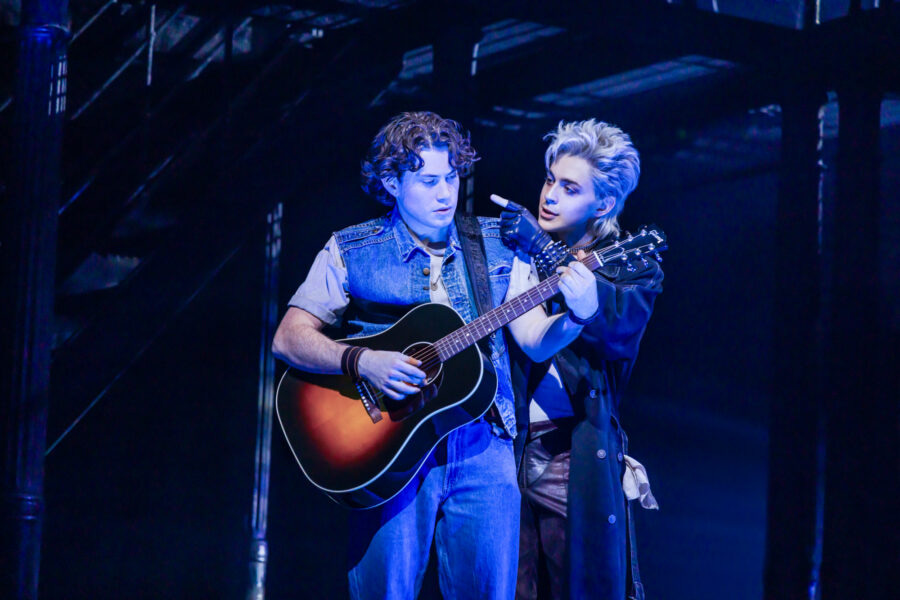
Early in the second act of The Lost Boys—after a lovely (albeit inorganic) duet between those consummate pros Shoshana Bean and Paul Alexander Nolan reignited my hope that this new musical could turn into something special, but before the dancing superheroes confirmed it’s as beyond redemption as the souls of the titular vampires—there’s a would-be rock anthem called “War” sung by the romantic female lead. “War” could also be the show’s mission statement given how determined it seems to attack our senses and standards.
Based on Joel Schumacher’s 1987 film of the same name, The Lost Boys follows the Emerson family as they try to start a new life in the boardwalk town of Santa Clara, California. Older brother Michael (LJ Benet) is resentful and rebellious. Younger brother Sam (Benjamin Pajak) is geeky and…well…gay. (You know your libretto is blunt when it makes a Joel Schumacher film look subtle and smart.) Mother Lucy (Bean) is unsure how to parent her children and make up for the years they spent with their abusive father (Ben Crawford), who haunts the family in nightmare sequences that handle domestic violence with all the sensitivity of a very special episode of Who’s the Boss?.
Trying to assert his independence from his biological family, Michael finds himself drawn to an elusive beauty named Star (Maria Wirries), but their romance is quickly complicated by her chosen family: a biker gang/punk rock band—yes, really—led by the seductive but sinister David (Ali Louis Bourzgui). They are, of course, actually vampires, and David is intent on recruiting Michael for their clan. Meanwhile, Lucy is courted by her new boss Max (Nolan)—apparently, workplace sexual harassment is fine if your boss is hot—and Sam is befriended by Edgar (Miguel Gil) and Alan Frog (Jennifer Duka), an archetypal pair of comic relief misfits who are the only people to rightfully suspect that Santa Clara is the “murder capital of the world” because it’s infested with vampires.
The Lost Boys desperately wants to have bite (pun intended), but feels cloyingly conventional. For starters, Michael and Star’s relationship could not be more of a musical theatre cliché. They fall in love instantly, earnestly, and without any interesting character traits. Furthermore, like many singing ingenues before her, Star is essentially a beard. The true and more propulsive attraction is between Michael and David, which obviously would not have been explored by a major studio motion picture in 1987, but should not have been so homophobically avoided by a Broadway musical in 2026.
Instead, a seemingly obligatory acknowledgement of the film’s queer subtext is made in David Hornsby and Chris Hoch’s book by cranking up Sam’s flamboyance, often with punchlines that position the audience to “laugh at the nance!” rather than with him. After having made a joke of Sam’s femininity for most of the evening, the writers then try to have it both ways and force a round of dutiful applause in Sam’s big solo by having him sing, “Maybe I can be a hero here / and make it cool to be queer. / Maybe that’s my superpower.” Maybe lyrics like those are my kryptonite.
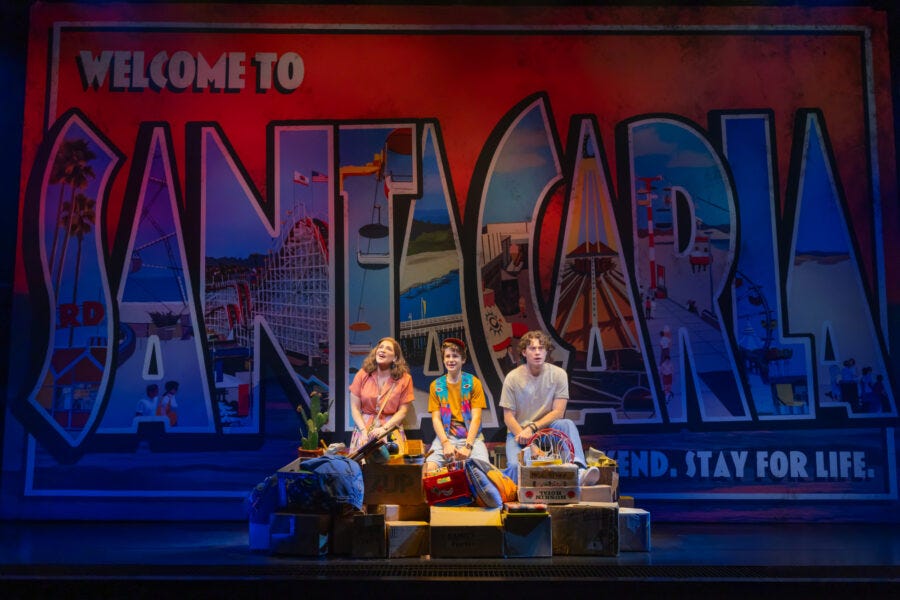
To be clear, though, my issues with The Lost Boys extend far beyond its treatment of queerness: its writing is fundamentally bad, not just bad for gay men. The score is credited to rock band The Rescues, but most of the lyrics sound like they were written by a middle schooler with access to ChatGPT and a rhyming dictionary. Consider the cliché-packed AABB rhyme scheme of the introductory verse to “Belong to Someone,” one of Michael’s big songs:
I don’t know who I’m supposed to be
It’s like I’m always fighting gravity
I hear something calling
But I feel myself falling
The chorus continues the clichés, but swaps out basic and/or mis-accented rhymes for near rhymes:
I want to belong to someone
Someone who can take my heart home
A home where I don’t always feel alone
I wanna belong to someone
Someone who is always near me
Someone who really hears me
Someone who can save me from me
If you’re familiar with the structure of musicals, you might read these lyrics—which are far from the worst in the show, but some of the only ones currently available online—and assume it’s Michael’s “I Want” song. Nope. It comes near the end of the first act, reflecting one of the musical’s larger structural issues of having characters frequently sing “I Want” songs without having transformed in any way since they last articulated the same desires. In fact, very few of the songs involve transformation, as they tend to lean into the vibes of a moment rather than move the plot forward or deepen the characters.
Are the lyrical inadequacies at least offset by the music? Unfortunately, not. Again, they’re desperate to serve punk and rock and roll; however, the edge those genres have is derived from far more than an onslaught of guitar solos and aggressive volume. (The borderline violent sound design is by Adam Fisher.) There are two or maybe three good songs, including the aforementioned Bean and Nolan duet, a reflective ballad for Bean, and a melodic closer where the entire ensemble spells out the moral of the story. The effective music shows The Rescues (who also did the vocal arrangements) have a notable talent for creating gorgeous harmonies. Everything else they’ve written—and there’s a lot of it—blends and blares together, underlining how much craft is at work in the composition of bona fide punk rock from the likes of the Ramones and the Sex Pistols.
Nevertheless, The Lost Boys garnered some positive reviews from respectable critics and a dozen Tony nominations. What about it has won folks over when I thought it made Redwood look like Next to Normal and Death Becomes Her look like The Producers? (Please note that I did enjoy The Lost Boys more than Heathers.)
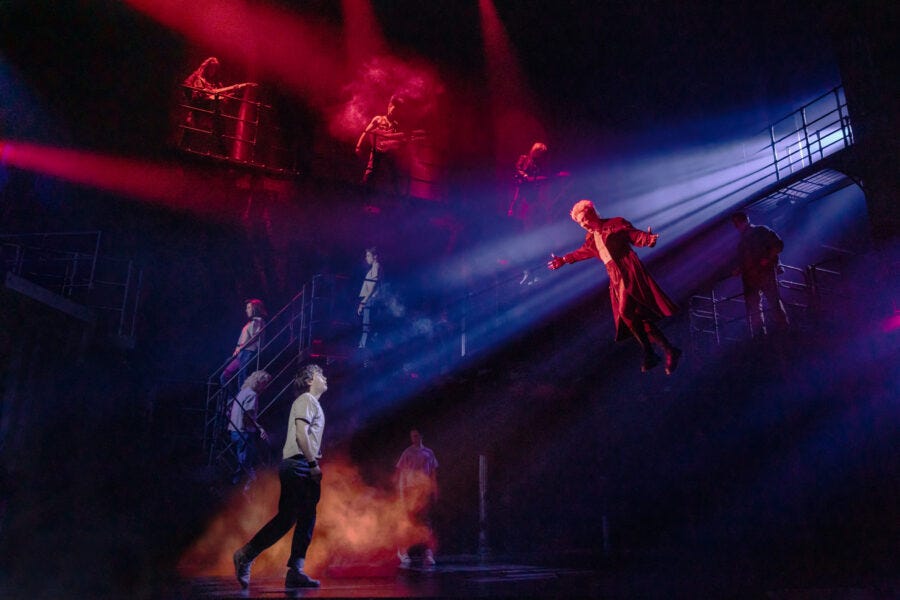
Much of the praise has affectionately described the production as bringing spectacle back to Broadway, and director Michael Arden has indeed assembled an impressive physical production. Visually oriented viewers will be understandably dazzled by Dane Laffrey’s gargantuan and atmospheric set—so long as they’re willing to overlook a climactic sequence where the extreme caution its upper level necessitates reveals that Arden and Laffrey have prioritized form over function. Sleek aerials, choreographed by Lauren Yalango-Grant & Christopher Cree Grant, never really best anything done in a good production of Peter Pan, but they’re still a lot of fun to see, as are Ryan Park’s 80s-inspired costumes. Arden and Jen Schriever co-designed the lighting, which is integral to making both the flying appear otherworldly and certain sections of the show genuinely feel like horror.
And therein lies the biggest problem in Arden’s direction—“certain sections.” Rather than mitigate the gross tonal inconsistencies in the book and score, Arden exacerbates them. The scenes with David lean into horror with surprising success; the scenes with Lucy and Max feel like something out of a Nancy Meyers dramedy; and the scenes with Sam and the Frogs play like a sitcom John Hughes might have done for the Disney Channel. Ultimately, the biggest danger to my neck wasn’t a pair of vampire fangs; it was genre-based whiplash.
Although no one in the cast is well served by this (mis)approach, no one is as hurt by it as Pajak, a promising young actor with sharp comic timing who can’t overcome having been directed to play Sam like the love child of Eugene Florzyck and Jack McFarland. Casting an actual adolescent as Sam comes with the advantage of authenticity, but the serious disadvantages of having an actor who’s very much still developing while also dealing with a voice that’s changing. Pajak’s shortcomings are accentuated by his constant juxtaposition with adult actors who are also playing teenagers, particularly Gil, a similar type who’s probably only a few years older but significantly more polished. Gil does such great work as Edgar, I kept wondering how it would change the piece to have him play Sam.
Benet is capable and sincere…but unexciting and fairly one-note. Bourzgui is charismatic and sexy…but opts to deliver an extended imitation of Kiefer Sutherland (the film’s David) that prevents him from registering as three-dimensional. Wirries has a powerful set of pipes…but acts with all the personality of a model in a soap commercial.
Adult roles tend to be thankless in most teen-centered dramas, and yet Bean and especially Nolan come off better than anyone. While Bean doesn’t convey the clear sense of character that Dianne Wiest did in the movie—admittedly, that’s a high bar—she is such a captivating singer that her more “every woman,” or more precisely “every mom,” interpretation works. Nolan expertly nails his dorky Reaganite character’s arc, again demonstrating that he’s one of New York’s most underrated shapeshifters.
They deserve better than The Lost Boys. So does nearly everyone involved. The Lost Boys may develop a fanbase because, like The Outsiders, it centers good-looking twinks and capitalizes on nostalgia. However, I am not horny or wistful enough for that to fool me into thinking it’s a good musical. If audiences as a whole are, we may be…lost.
the not-a-bottom line
🌈 (out of five)
a guide to ticket-buying
The Lost Boys is playing at the Palace Theatre, one of Broadway’s biggest houses. Avoid sitting in the balcony, which is so high up, it’ll feel like you’re watching from Ontario.
Choose being center over being closer. Although they’re not selling the sides as obstructed view, they essentially are.
a key to the pictures
Following an interview with coproducer Patrick Wilson, the cast performs a medley on Good Morning America
The original film is available for rental or purchase on all the obvious streaming platforms, but is not included as part of a subscription with any of the big ones (Netflix, Hulu, etc.)
Everything I read about TLB and Heathers makes me realize that the 80’s doesn’t fit in with today’s sensibilities, at least not theatrically speaking. It was a real “fuck your feelings” decade and any attempt to soften or explain it away with a trauma plot ruins it. There was glitter in the blood that the characters drank in the film, it’s not that serious.