The Balusters
A comedy examining which traditions are worth continuing continues a long tradition

David Lindsay-Abaire has a Pulitzer Prize for Rabbit Hole; two Tony Awards for the musical Kimberly Akimbo, which he co-adapted from his play of the same name; and, in addition to a slew of other nominations for plays as varied as the deliriously silly Fuddy Meers and the gut-wrenching Good People, both a Drama Desk Award and an Outer Critics Circle Award for his new comedy The Balusters. And yet I think he’s still somehow underrated. When people discuss our great living playwrights, I never hear Lindsay-Abaire named; only Rabbit Hole has received a film adaptation; and The Balusters, despite its nominations, has not been flagged by prognosticators as a serious contender for this year’s Tony Award for Best Play.
Nevertheless, Lindsay-Abaire has crafted an impeccably structured and hilarious play that grapples with something real and relevant while also featuring characters whose voices are fully differentiated from each other. In other words, The Balusters ticks nearly all the boxes for great playwriting, demonstrating once again that Lindsay-Abaire is a master of his craft…in all ways except, perhaps, originality. Early works of his, like Fuddy Meers and Wonder of the World, were fairly “out there” in concept, but The Balusters, like Rabbit Hole, represents exceptional execution of a fairly familiar concept.1
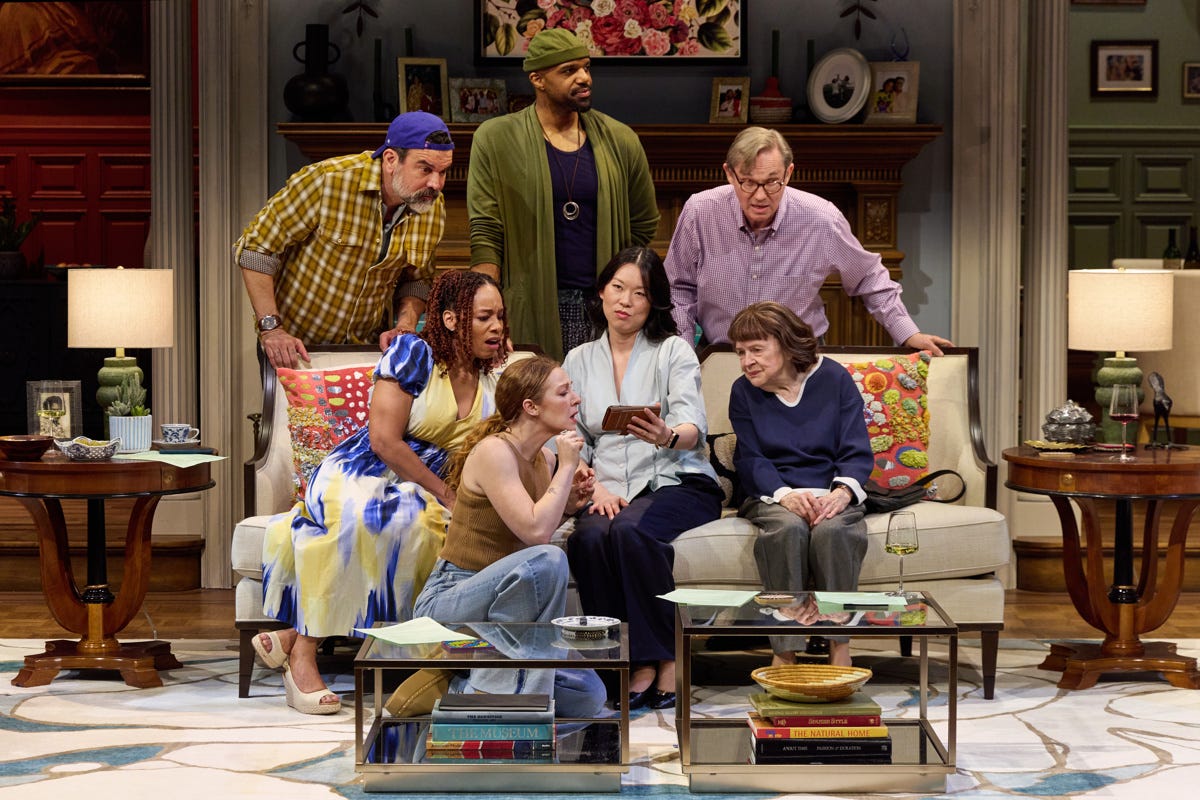
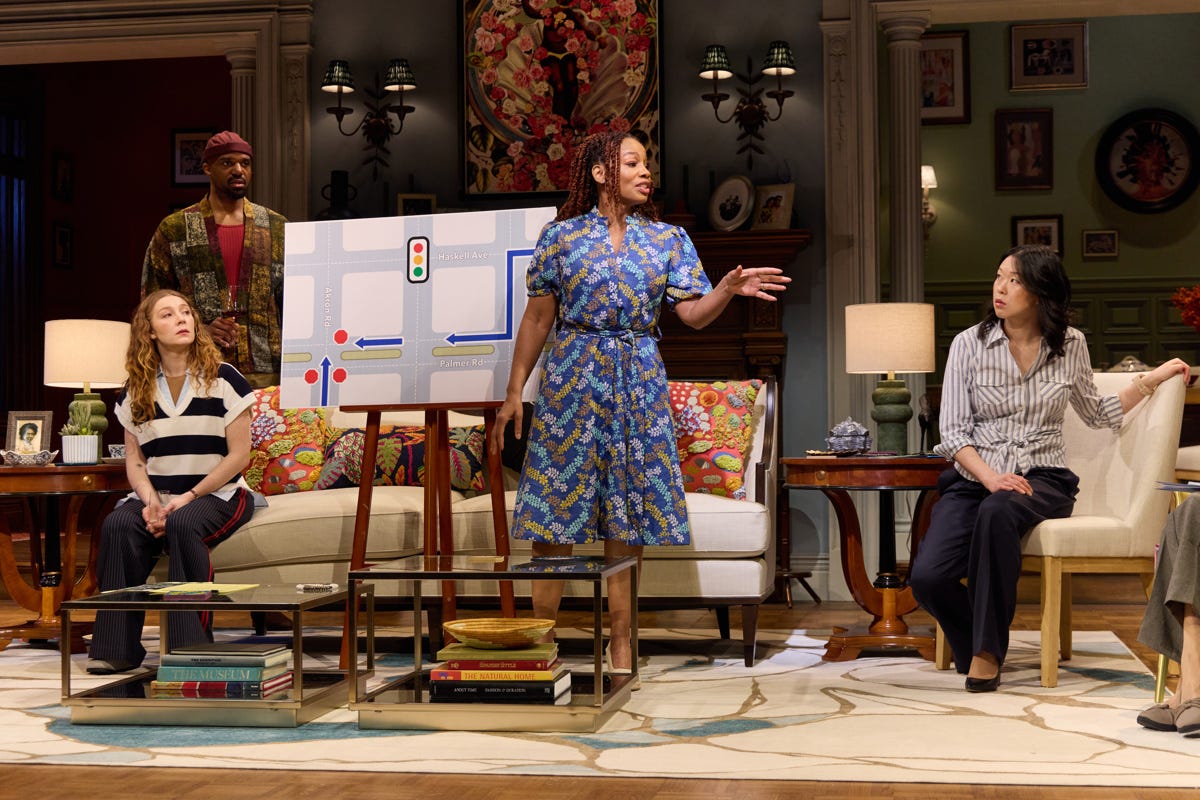
So what is that concept? Kyra (Anika Noni Rose) and her family have recently relocated to a picturesque and historically landmarked suburb where her desire to have a stop sign installed on a nearby corner leads her to join the local homeowners’ association, which is ruled over by neighborhood lifer Elliot (Richard Thomas) with an air of sweet-tempered tyranny. They immediately clash over her proposal and begin jockeying for support from the other members of the group: wily septuagenarian Penny (the sublime Marylouise Burke, also delivering familiar shtick, but doing so brilliantly); Elliot’s effortfully woke goddaughter Willow (Kayli Carter); performatively salt-of-the-earth Isaac (Ricardo Chavira); imperious travel writer Brooks (Carl Clemons-Hopkins of Hacks in an effortlessly convincing Broadway debut); acerbic instigator Ruth (Margaret Colin, so hilarious that Steel Magnolias should be revived just so she can play Ouiser); perennially ignored Alan (Michael Esper); and over-everyone’s-shenanigans board VP Melissa (Jeena Yi, who has razor sharp comic timing). Throughout the group’s meetings, everyone is served wine, refreshments, and a Mona Lisa smile by Kyra’s housekeeper Luz (Maria-Christina Oliveras, marvelously grounded), who recently left Elliot’s employ under circumstances as mysterious as those surrounding Kyra’s departure from her last neighborhood’s board.
Understandable comparisons have been drawn between The Balusters and both Tracy Letts’s The Minutes, which unfolds during a city council meeting, and last season’s revival of Jonathan Spector’s Eureka Day, which not only concerns a school board facing the same kind of prosaic pain points, but also was produced at the same theater by the same company (Manhattan Theatre Club). The truth is that the origins of The Balusters extend all the way back to the 17th and 18th centuries when writers like Molière, William Congreve, and Oliver Goldsmith created the comedy of manners, plays skewering the upper class’s obsession with status and pretentious social customs. If that description strikes you as stuffy or antiquated, think of how the tradition was continued by Oscar Wilde and Noël Coward in the 19th and 20th centuries and then transferred to television in an even more accessible format with sitcoms like Frasier and Arrested Development.
With its setting in a modern-day aristocrat’s modern-day drawing room (the luxurious set is designed by Derek McLane), The Balusters fits into this lineage even better than The Minutes and Eureka Day. What Lindsay-Abaire adds—and what feels more like his trademark than the whimsical anarchy that put him on the map—is a sense of abundant compassion for his characters, even as he reveals their baser natures. It’s a quality that Kenny Leon expertly maintains and maybe even accentuates in his direction of the play.
It helps that Leon has assembled one of the finest ensemble casts to grace a Broadway stage in recent memory. Their chemistry is delicious, and their rapport suggests a group of people who really know each other, which, of course, would be true of these characters. At the company’s center are the perfectly cast Rose and Thomas. It’s Rose’s best stage work since her breakthrough in Caroline, or Change, cleverly capitalizing on her preternatural poise, and Thomas calibrates his performance with an expertise that is hard to imagine anyone else matching.
The Balusters may underwhelm some audience members because it doesn’t do anything especially new. I can’t argue that it advances the form; instead, it demonstrates why a specific form has endured so long. Like the best comedies of manners, it offers excellent entertainment and germane social critique. Other writers might have been more ruthless in their commentary, but Lindsay-Abaire’s generosity is a major reason why the play lingers. Exposing these people’s hypocrisies while simultaneously highlighting their humanity takes a truly great playwright, and it’s time that Lindsay-Abaire be recognized as such.
the not-a-bottom line
🌈🌈🌈🌈 (out of five)
a guide to ticket-buying
My only strong piece of seating advice is to avoid the first row of the front mezzanine at the Friedman where the view of the stage is typically bisected by lighting equipment, even though Manhattan Theatre Club does not sell it as obstructed.
The original iteration of Kimberly Akimbo and his highly underrated Ripcord stand out as the most aesthetically balanced of Lindsay-Abaire’s plays.