Color Theories
A Critwink* from the Intelligent Showmosexual

*In case you missed it: “critwinks” are mini-reviews turned out in a single draft

As befits its subject, this critwink of Julio Torres’s Color Theories is not going to proceed in any traditional fashion.
I’m going to start with a related tangent and reference a slew of other works of art before I even get to Color Theories.
Recently, a group of friends and I saw Figaro/F*ggots, which creator Kevin Carillo explained is a “transform[ation of Mozart’s classic opera] with words and scenes from gay rights activist Larry Kramer’s incendiary novel.” Despite only having been scheduled for a three-day run, the production somehow managed to procure a soft rave from The New York Times. The review would have made sense to me if the Times were a newly tenured professor critiquing their star pupil’s Master’s thesis because the whole affair ultimately felt more academic than theatrical to me. Still, Carillo is a rising talent to watch. His piece included some haunting imagery and a myriad of interesting ideas—so many, in fact, that I found myself thinking of the inevitable moment on each season of Drag Race when Michelle Visage responds to a promising queen’s creative but chaotic runway by saying something like, “One word: edit.”
I often joke that there’s been no greater influence on my taste than my mother, who would choose which shows we could see based on where she could check her mink and valet our Caddy. (Another joke. Mostly.) So, over a post-show dinner, when my friend Song asked me what I thought of Figaro/F*ggots, I categorized it as a genre of theatre I am just “too square” to really enjoy . Being a good friend, he assured me—as I ate my soup dumplings with a fork and knife—that I’m hip.
Nevertheless, when Ava, another dear friend, suggested that we see Color Theories, I braced myself for another experience I wouldn’t really “get.” Even the production’s press release described it in terms I found annoyingly obtuse: “Fresh from winning a 2025 Peabody Award for his HBO series Fantasmas, Color Theories finds Torres—an Emmy-nominated writer-director-performer—blending stand-up, design, and dream logic into a whimsical exploration of color, emotion, and identity that is equal parts comedy, theatre, and art piece.” WTF was I being asked to see? And shouldn’t references to “dream logic” in everyday marketing materials come with trigger warnings?!
But Ava has known me, and been seeing theatre with me, for a long time. Though I was totally unfamiliar with Torres’s work, her thinking I would enjoy it meant something. I certainly dug (not to mention saw myself in) the “Wells for Boys” SNL sketch that Torres wrote, which Ava sent me as an introduction to his aesthetic. Plus, I took her to The Trees at Playwrights Horizons, so I *really* owed her one.
I left Color Theories with newfound empathy for the team who had to draft that press release because the show we saw was so wholly original, it practically defies description. Which of course means I’m now going to try providing one.
After emerging from the floor of Tommaso Ortino’s ingenious set (a delightful and consistently surprising fusion of references to popup books, Salvador Dalí, and children’s television programming), Torres tells us that what we’re about to see is not “an off-Broadway play,” a genre he names with clear disdain. Instead, it is a “First Avenue thing.” His announcement subtly sets the stage for an evening-long exploration of our collective obsession with classification.
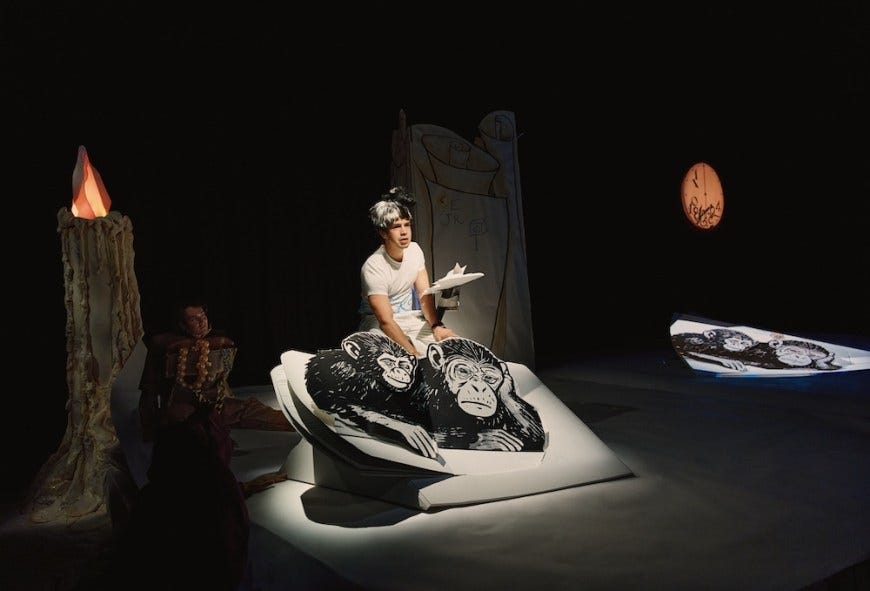
Torres elaborates that we’re actually a test audience for a lecture he’ll supposedly soon be touring through New York City’s public schools as mandatory viewing for students—a feat he claims to have pulled off by donating a whopping $130.00 to Zohran Mamdani’s mayoral campaign. “The man is my puppet,” he deadpans. With the silent assistance of a human Music Box (Nick Meyers) and human Spilled Wine (Drew Rollins), and occasional interruptions from the very vocal taskmaster of a robot named Bilbo (Joe Rumrill), Torres majestically rolls around the set in a painter’s chair like a super stoned, super gay Bob Ross, taking us through his color theories.
What exactly are color theories? They’re the personalities, uses, and psycho-emotional connotations of the colors, as perceived by Torres. For example, navy blue is law and order. They’re also the visual manifestation of certain behaviors and characteristics. For example, Barbra Streisand cloning her dog is purple. In perhaps anyone else’s hands, these color theories wouldn’t be enough to hang a whole play on, but in those of a masterful storyteller like Torres, they become riveting.
They also become a celebration of synesthesia and, arguably by extension, neurodivergence in general. At a time when our government is pathologizing and belittling neurological difference, being invited into Torres’s way of processing the world is illuminating: not only is his perspective enchanting, the longer we share it, the more we see how it makes its own sense. And, if it wasn’t already clear, Torres is really fucking funny. His take on what the cover of the Catholic bible should be has had me giggling inappropriately for days.
Color Theories very much feels like it’s in dialogue with another recently closed one-person show written and performed by a queer multihyphenate, Josh Sharp’s ta-da!1. Both shows grapple with the constraints put on us by time. Both shows feel almost musical in the way their rhythms reflect their creators’ unique comic voices. Both shows push the boundaries of what theatre is or should be by blending it with standup comedy and performance art.
Which, quite appropriately, brings us back to categorization and classification. And Color Theories reminded me of a truism that I had forgotten when processing my reaction to Figaro/F*ggots: when something is truly good, it can transcend genre.
the not-a-bottom line
🌈🌈🌈½ (out of five)
a guide to ticket-buying
Color Theories has extended one last time, through this weekend. Sit anywhere you can to see it, but, if you’re able, choose center or house left over house right.
I revisited ta-da! during its closing week and found even more to love the second time. Consider its rating bumped up to 🌈🌈🌈🌈. If it plays a return engagement, go.
I love this. I felt like it was one of the most original works of any genre I’ve seen in a long time. And I’m reminded how life-giving originality is. I haven’t been able to look at any color - especially navy blue - since. And I am still laughing about the bit about the cell phone having a soul. Also the clock set piece was EVERYTHING.
If you can catch Torres's My Favorite Shapes on HBO Max, do so! Bibo was a holdover from his HBO show Fantasmas which shares a lot of DNA with Color Theories. His film, Problemista is the best look at the grind of trying to secure sponsorship to stay in The US. Of course Papyrus and Papyrus II are the best rationale for the Avatar films.