Bug
A Critwink* from the Intelligent Showmosexual

*In case you missed it: “critwinks” are shorter reviews turned out in a single draft
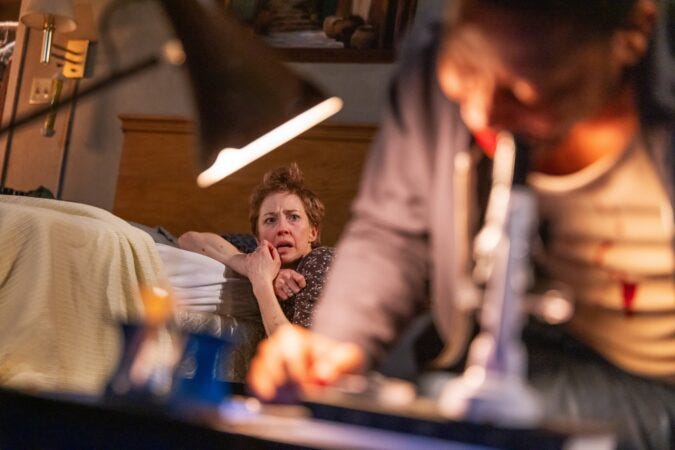
Horror, as a genre, has long allowed its creators to reflect and exploit the social concerns of the era in which they’re working, regardless of the medium being used or time period. For example, on the page, Mary Shelley’s Frankenstein grappled with the rapid scientific advancements of the Industrial Revolution all the way back in 1818 while, on the silver screen, nearly 200 years later, Jordan Peele’s Get Out explored institutional racism in 2017. In his book The Monster Show: A Cultural History of Horror, David J. Skal refers to horror as a “shared anxiety ritual[ ]” because it dramatizes the societal ills that most frighten us; furthermore, in forcing us to confront them, it can trigger collective awareness and, hopefully, progress.
“Shared anxiety ritual” also happens to be an ideal way to describe what’s experienced by both the characters and audience of Bug. Although David Cromer’s revival of Tracy Letts’s play marks its Broadway debut, it has already enjoyed a long life, first premiering in London in 1996 before a revised version played Washington, D.C.; Chicago; and, finally, New York City where it ran off-Broadway from 2004-2005. William Friedkin—director of The Exorcist, one of the all-time greatest horror movies—helmed an underrated film adaptation that was released in 2006.
But the timing of Bug has never felt more relevant. It has new and painful resonance following the global pandemic (which brought a slew of its own shared anxiety rituals) and the culture of conspiracy theories fed by—and resulting in the political ascent of—Donald Trump and his supporters. The play seems to be in such direct dialogue with those events, if I’d been unfamiliar with its history, I would’ve guessed it was a response to them; knowing it’s not, the prescience of Lett’s writing adds to the evening’s eeriness.
When the curtain rises, we meet Agnes White (Carrie Coon), an Oklahoma waitress living out of a motel room and fielding mysterious calls from a heavy breather, whom she suspects is a violent person from her past. She has her bestie over to let off some steam and is introduced to Peter (Namir Smallwood), a stranger who’s sweet but…well…strange. As the bond between Agnes and Peter intensifies, so do their fears of threats from the outside world, which may or may not be related to past traumas each is trying to outrun.
If my overview of the plot seems vague, it’s partly because I’ve recently been dog-walked for divulging too much in my summaries; however, it’s even more related to the way Letts uses ambiguity to build suspense. Bug is often referred to as a psychological thriller, which is neither a perfect not inaccurate label, and it’s the uncertainties and secrets in Agnes and Peter’s story that keep the audience on edge. If you’re a theatergoer who needs clear answers, Bug is probably not for you.
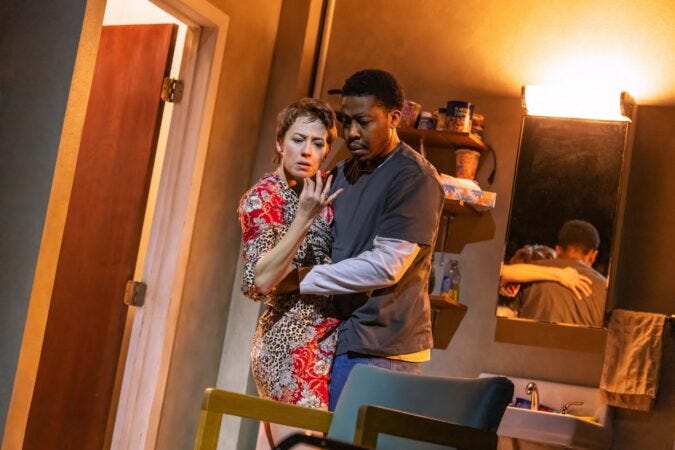
Personally, I don’t mind the lack of clarity—not only because tolerating ambiguity is a sign of genius (natch), but because Bug is less about what happens than how Agnes and Peter respond to it. In other words, it’s a character study. As such, the effectiveness of any production pretty much rests on the shoulders of the actors playing the two central roles. Here’s where Cromer’s production both flies and lands in theatrical fly paper.
Coon pilots the production to its highest heights. The tomboyish bravado her Agnes assumes as a survival mechanism does not conceal that she is, in actuality, a raw, exposed nerve. Coon expertly conveys this vulnerability and desperation without ever becoming heavy handed. Other actresses have been fantastic in the role, yet Coon’s performance feels definitive.
Smallwood, on the other hand, cannot exterminate the hovering presence of Michael Shannon, who delivered the definitive take on Peter in the original London, Chicago, and New York productions and later preserved it in Friedkin’s film; it would become his breakout role on camera in a career that currently includes two Oscar nominations. Smallwood is never as fragile or menacing as Shannon. Even without looking at his more boyish interpretation through a comparative lens, he lacks the weird magnetism necessary for Agnes’s fascination with him to be about him specifically. Instead, it feels entirely rooted in her own pain, which leads you to invest more in her than their relationship. Consequently, the play becomes Agnes’s story rather than their story.
Other aspects of Cromer’s production run a similar gamut. In terms of the supporting cast, Jennifer Engstrom is perfect as Agnes’s lone friend, so totally believable it seems like she was plucked from a Publix parking lot in Lawton, and Randall Arney is intriguingly impenetrable in a brief but highly impactful appearance. Steve Key, though, plays his role with less subtlety than a villain on Batman. The Adam West Batman. Takeshi Kata’s scenic design intelligently mixes hyper-realistic re-creation with fun surprise; neither he nor Cromer, however, quite figured out how to scale what is a quintessentially off-Broadway show to a Broadway theater. Gigi Buffington’s coaching yielded some of the most specific dialects I’ve heard in a while, but Marcus Watson’s fight direction often appears rudimentary.
The end result is a production that doesn’t make as strong of a case for the play as its timing or leading lady’s performance. That’s a shame because, as a text, Bug probably has wider—and more profound—social implications than Letts’s Pulitzer and Tony winning smash hit August: Osage County (which my friend Raph referred to as “a really good episode of Mama’s Family”). This revival may not recontextualize Bug as Letts’ true masterwork, but, given the tour-de-force Coon is delivering, the Tony contest for Best Actress in a Play has definitely…hatched.
the not-a-bottom line
🌈🌈🌈 (out of five)
a guide to ticket-buying
As mentioned, Bug feels a bit swallowed up by a Broadway-sized theater. I was in row H, and it felt too far away. At the same time, the stage is high, so I’d avoid sitting in the first two or three rows.
Bug offers $49 rush tickets through TodayTix. I don’t know where they’re located, but I will caution that, in past visits to the Samuel J. Friedman Theater, I’ve always felt that the first few rows of the mezzanine should be sold as partial view because the stage is bisected by lighting equipment. That being said, I got a $45 rush ticket directly from the box office a few hours before a Sunday evening show.
a key to the pictures
Friedkin’s film adaptation is available for rental on Amazon Prime and AppleTV. It streams for free on several commercial-based platforms, including Tubi and Pluto. Shannon is dynamic and dynamite in what may still be his best screen performance. Ashley Judd is so persuasive as Agnes, it really makes you wonder what she could have accomplished in her film career were it not for Harvey Weinstein.